
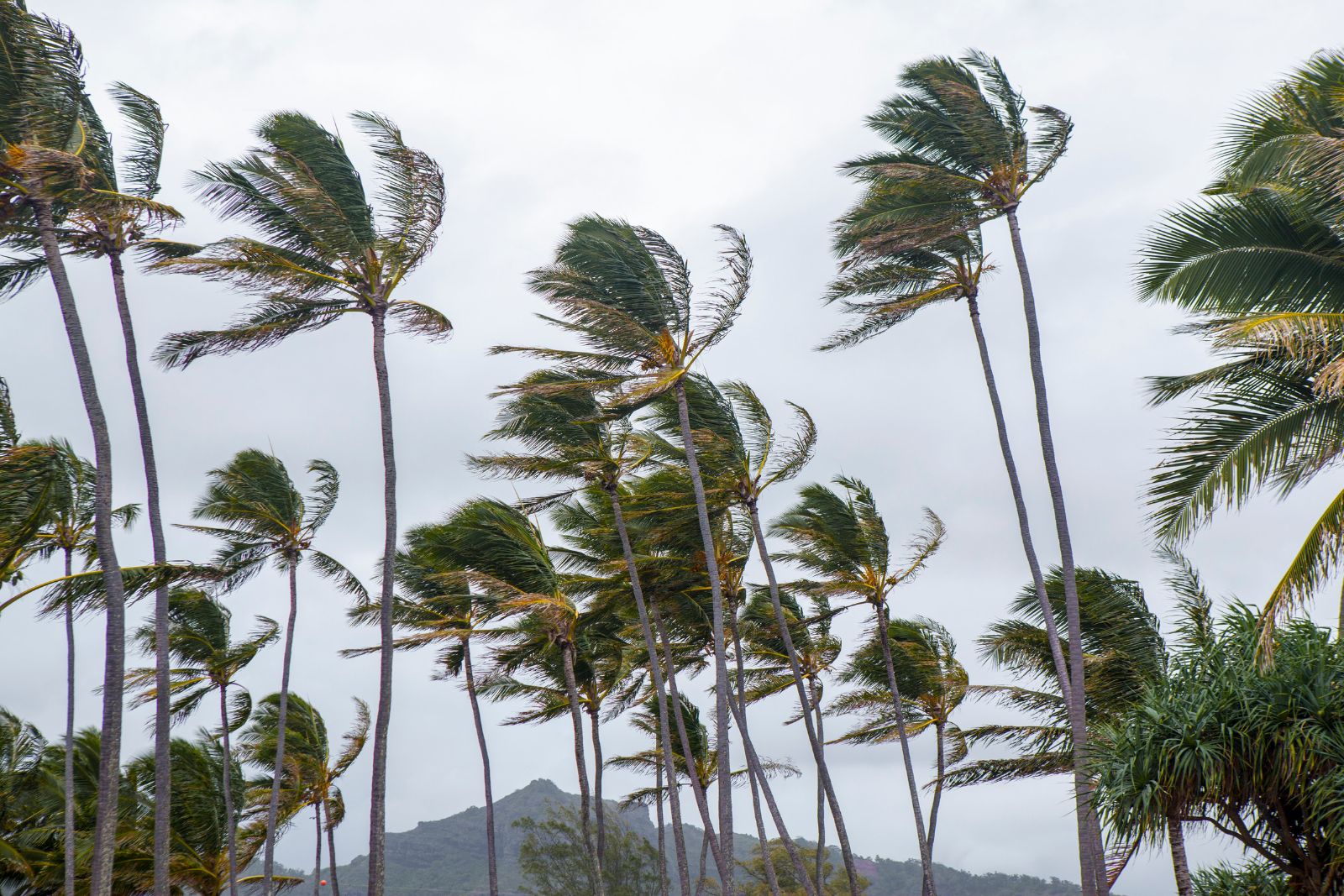
Hawaii had a busy hurricane season in 2026; Lala, Lowell and Nolo passed our islands less than two months apart. None of them made landfall, but there was plenty of damage and manta ray tours were affected, which led to a lot of questions – from guests who waited patiently for a safe time to swim with manta rays, and from our crew, who experienced some of it in person.
Hurricanes affect manta rays in two main ways. During and right after a storm, rough water keeps the mantas away from the spots where they usually feed. Over the longer term, storms damage the coral reefs mantas depend on, and that damage can take years to recover.
Hurricane season in Hawaii
A hurricane (that’s what cyclones are called in the Atlantic and in the central and eastern Pacific) is a storm where winds reach 74 mph (119 km/h).
Hurricane season here in Hawaii runs from June 1 to November 30, and is heaviest from July to September. In an average year, four or five tropical cyclones pass through the central Pacific, but most of them weaken by the time they get here or don’t make landfall, so direct hits are rare.
The two that most people here remember are Hurricane Iwa in 1982 and Hurricane Iniki in 1992 – both on Kaua’i.
We expected heavy storms in 2026: in May, NOAA forecast 5 to 13 tropical cyclones in the central Pacific, well above the usual four or five. This was mostly due to El Niño, the natural pattern that warms the tropical Pacific every few years.
On August 15, Hurricane Lala, a Category 1 storm, skirted South Point, the southern tip of the Big Island. Its rain turned small streams into full rivers, swept homes off their foundations and buried roads in mud. In total, Lala dropped enough rainwater on Hawaii to fill 1.9 million Olympic swimming pools, in just four days.
Three weeks later, on September 7, Hurricane Lowell swept past Kaua’i. It stayed a few hundred miles away from the Big Island, but its westerly swell rushed straight into Kauna’oa Bay, where we take guests to snorkel with manta rays every night.
And before September was over, on the 25th, Hurricane Nolo stalled about 185 miles (300 km) south of the Big Island as a Category 2 storm. A few days later, Nolo turned north and stalled again, this time west of Kaua’i, before it finally moved away from the islands in early October.
Manta rays and hurricanes
When a hurricane is forecast to come close, we cancel our swims ahead of time and let guests know as early as we can. Once the swell rolls in, the surface gets choppy, sand lifts off the bottom, and visibility drops. After Lowell, that meant several days without swims – much like what happens with big winter swells.
The mantas stay away too. In Kona, they usually gather at night at a few manta ray viewing sites, where lights draw in the plankton they feed on. When the water is stirred up and murky, the plankton gets scattered, so the mantas don’t come in to feed.
Nobody has tracked mantas during a hurricane yet. The closest thing we have is a 2026 study in Papua New Guinea that followed reef mantas through two monsoon seasons. Three out of four stayed and hid out within 6 miles (10 km) of where they were tagged.
We think the Kona mantas wait out storms nearby in a similar way. Between Lala and Lowell, many of our regulars came back to Kauna’oa Bay, including X-Wing, Vegemite Ray, Obama Ray, Louisette, Jolene Ray, Pu’uwai and Georgia.
Even once the ocean calms down, it takes a while for things to settle. In the Gulf of Mexico, scientists found that hurricanes stir up nutrients, and that rain and runoff change which kinds of plankton thrive near the coast. Storms can even push plankton away from the animals that feed on it.
At the viewing sites, we don’t see that effect: once the water clears, the lights draw the plankton back in quickly. And since the mantas are used to the viewing sites being a great source of food, they’ll come to feed here, even between major storms.
Elviki Ray’s unexpected trip to Maui
Unlike their oceanic relatives, reef mantas don’t migrate. The Kona mantas live along this coast all year, and most of them stay close to home.
This season, one of them went a lot farther. Elviki Ray is a young female from the Kona population, first seen as a pup in 2017. She usually feeds at the Keauhou viewing site, where she was last seen on July 24. Then, on September 9, two divers photographed her at Molokini, a small island off Maui.
That was a first. Maui and the Big Island are only about 30 miles (48 km) apart, but the mantas stay around their own island. A 2023 genetic study even found that female reef mantas only breed around the island where they were born, and that a female moves between the two island groups about once every 1,300 years – so the two gene pools have stayed fairly separate.
Elviki turned up at Molokini two days after Lowell, and less than a month after Lala. The timing makes us wonder whether the storms pushed her across, but it may have been a coincidence; she may have followed food, or simply swum farther than usual. We have no way of knowing for sure.
Either way, manta lovers everywhere can’t wait to see whether Elviki will stay and breed with the Maui mantas. If she does, she could bring new genes into a population that has been separate from ours for a very long time.
Fixing hurricane damage to coral reefs
A storm passes in a day or two, but a damaged reef can take years to recover. The coral reef is where our beloved mantas feed, spend time at cleaning stations, and spend most of their lives; a healthy reef is essential to their survival.
How waves and runoff break and smother coral
Hurricane waves hit reefs with huge force. Lala and Lowell turned entire areas of Hawaii’s reefs into rubble. Coral colonies 6 to 8 feet (about 2 meters) wide, which took centuries to grow, were ripped loose and thrown around. The loose pieces broke more off as they tumbled and went, even knocking over large corals that had survived both Iwa and Iniki.
Lala hit reefs hardest off West O’ahu and the Big Island, while Lowell’s damage was more widespread; on Kaua’i, live corals even washed up on the beach.
The rain did its share of damage: all that floodwater from Lala had to go somewhere. Stormwater runoff carries mud and sediment from land into the ocean, where it blocks sunlight, settles on corals and smothers them. The fresh water also lowers the salt level corals need, and the extra nutrients feed algae.
The mud and runoff sometimes do more damage to the corals than the waves. Surviving corals are often weakened, which leaves them open to infection, and the lack of sunlight from muddy water can cause reefs to bleach.
Sometimes, the storms have a small silver lining. Hurricanes can cool the water for a while; in the Gulf of Mexico, Hurricane Rita left cooler water behind that helped corals through a bad bleaching event. But that cooling helps less and less as the ocean gets warmer.
The race to reattach broken coral before it dies
When a wave snaps a piece of coral off the reef or flips a colony upside down, that coral isn’t dead yet. That’s when repair teams come in to pick up the broken and overturned pieces and glue them back onto the reef. They use cement, epoxy and other underwater adhesives that are safe for marine life. Once a coral is fixed in place again, it has a chance to survive and keep growing.
Time is of the essence, as corals can’t survive for long loose on the sand or tumbling around in the surf. Most broken coral only lasts about 45 days off the reef. The clock starts ticking as soon as the storm passes, but divers can’t always get in right away. After Lala and Lowell, brown water advisories (warning divers of muddy runoff) kept repair teams out of some areas for up to two weeks.
Sometimes though, the rubble has a use: some of it becomes shelter for small reef animals. So the divers don’t necessarily repair every single bit of reef.
In Hawaii, the coral repair work is done by the Hawaii Emergency Reef Restoration (HERR) Network, an emergency response team for reefs made up of government agencies, universities, nonprofits and community groups. After a storm, they survey the coast to find where the damage is, then send divers in to reattach what they can.
For instance, at the end of 2025, large winter surf broke and overturned corals in Kahuwai Bay on the Kona coast. Afterwards, teams from the network reattached 313 coral colonies.
After Lala and Lowell, the scale was much bigger. Within a week and a half after Lala, teams had surveyed about 30 miles of Big Island coastline, and they reattached more than 200 corals in a single day. On Kaua’i, one team alone reached more than 2,000 coral colonies after Lowell.
How well a reef recovers depends a lot on how healthy it was before the storm. Reefs that are already weakened by everyday threats like pollution and overfishing have a harder time bouncing back.
For the mantas, every coral that’s saved is part of a cleaning station or a feeding ground that doesn’t have to regrow from scratch.
Hawaii’s coral reefs have their own insurance policy
Repairing a reef isn’t cheap, so in Hawaii, some of the money comes from a coral reef insurance policy. Mexico was the first to insure a coral reef, and The Nature Conservancy followed with Hawaii’s policy in 2022, with help from donors. It was the first coral reef insurance policy in the US.
It’s a parametric policy, which means it doesn’t pay for proven damage; it pays out based on the storm itself. If a storm with winds of at least 50 knots (57 mph) passes close enough to the islands, the payout is triggered automatically. The stronger the storm and the closer it comes, the bigger the payout, up to $1 million per storm and $2 million a year.
Broken coral can’t wait for an adjuster to come out and assess the damage. With this type of insurance policy, the money is available as soon as the repair teams need it.
In 2026, the policy paid out for the first time: $200,000 after Lala, and another $300,000 after Lowell. Less than two weeks after Lowell, that money was already funding repair work in the water.
Preparing for more hurricanes in Hawaii
Hurricanes have always been part of life in Hawaii, but three this close together isn’t normal, even in hurricane season. This year’s intense and busy season was mostly due to El Niño, but something is shifting: scientists expect two to three times more storms near the islands by the end of this century, and they are likely to pass closer to the islands. Seasons like 2026 could become a lot more common.
The mantas have weathered storms for many millennia, and as long as the reefs stay healthy, we expect they’ll keep doing so. What worries us is that more storms leave the reefs less time to recover in between.
While we can’t stop the storms, we can help the reefs get ready for them: by protecting the coral from everyday threats, and by supporting the people who repair them after a storm.




0 Comments