

As of 2026, there are three officially recognized manta ray species.
For most of human history, we believed there was just one type of manta ray. Then, in 2009, researchers confirmed two distinct species (the reef manta and the pelagic/oceanic/giant manta ray). And in July 2025, scientists formally described a third species that’s been swimming in the Atlantic Ocean all along: the Atlantic manta.
Let’s take a look at the differences between these three types of manta rays and what makes them unique.
Meet the three manta ray species
Before we dive into the differences, let’s get the names straight. There’s a lot of confusion out there, and even though all of them are huge, only one of them is called “giant manta ray.”
Reef manta ray (Mobula alfredi): The coastal species that sticks close to reefs and shorelines. They’re most commonly found in the Indo-Pacific region; these are the manta rays we encounter when we take people to snorkel with mantas along the Kona shoreline.
Giant manta ray (Mobula birostris): The largest of the three species and the most migratory, roaming across all the world’s major oceans. It’s also called oceanic manta or pelagic manta ray, because it lives and feeds in the open ocean – the pelagic zone.
Atlantic manta ray (Mobula yarae): The newest addition to the family, formally described in 2025. These are found throughout the western Atlantic Ocean, from the eastern United States to Brazil, including the Gulf of Mexico and Caribbean Sea.
Difference #1: Giant manta rays are the biggest
Size is often the first thing people notice about manta ray differences, though it’s not always the most reliable way to tell them apart.
The giant manta ray lives up to its name. They can reach a wingspan of up to 22 feet (about 7 meters), with some historical accounts suggesting even larger individuals. They’re the world’s largest rays.
The Atlantic manta ray comes in second. Mobula yarae can grow to wingspans of 16-20 feet (5-6 meters), making them impressively large but still smaller than their pelagic cousins. Many of the Atlantic mantas observed so far have been juveniles, so we’re still learning about their maximum size.
The reef manta ray is the “smallest” of the three, though calling any manta ray small feels wrong. Reef mantas typically reach wingspans of 10-15 feet (3-4.5 meters).
Here along the Kona Coast of the Big Island of Hawaii, Big Bertha is one of our largest regular visitors, measuring about 14 feet across. She’s huge by reef manta standards but would be average-sized for a pelagic manta.
If you encounter a young pelagic/oceanic or Atlantic manta, size alone won’t help you identify it. That’s where other identification features become important.
Difference #2: Habitat, distribution, and migration patterns
Each species has carved out its own niche in the ocean.
Reef mantas prefer coastal areas, coral reefs, and lagoons. They’re found throughout the tropical and subtropical Indo-Pacific, including Hawaii, the Maldives, Indonesia, the Philippines, Mozambique, Australia, and Fiji (find out where they can be seen in the wild in this article).
Along the coasts of Hawaii, the reef is right along the shoreline, which makes sightings a frequent event, especially during the night at the manta ray viewing sites, where they come to feed.
Pelagic or giant mantas are found in tropical, subtropical, and temperate waters worldwide, making them the most widely distributed of the three species. They travel long distances and don’t stay in one place for long. Sometimes they come closer to shore, but sightings are much less common.
I’ve been diving around Hawaii for over 25 years and have seen countless reef mantas but only a handful of pelagic ones.
Atlantic mantas prefer coastal habitats like reef mantas. They’re found in tropical and subtropical waters throughout the western Atlantic Ocean.
Scientists theorize that ancestral oceanic mantas may have crossed the Atlantic, discovered abundant food along inshore reefs, and gradually evolved into this distinct coastal species.
Difference #3: Distinctive colors and patterns
Once you know what to look for, color patterns are one of the easiest ways to tell manta ray species apart.
Reef mantas usually have a dark gray back with two lighter patches on their head, which form a soft Y-shaped pattern. The area around the mouth and the cephalic fins is white. On their underside, they have a white belly with dark spots that can spread between the gill slits.
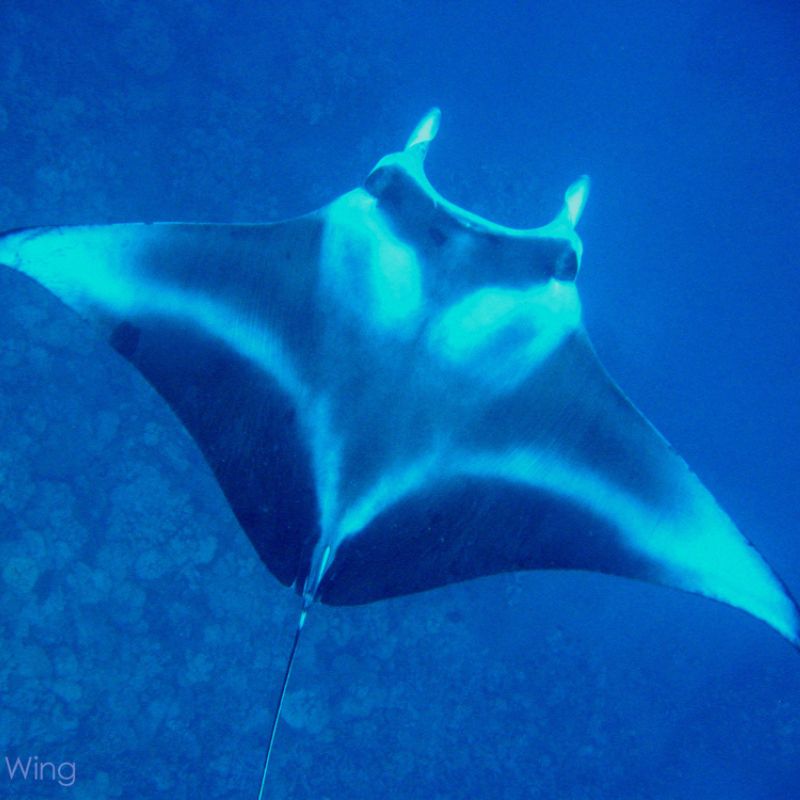
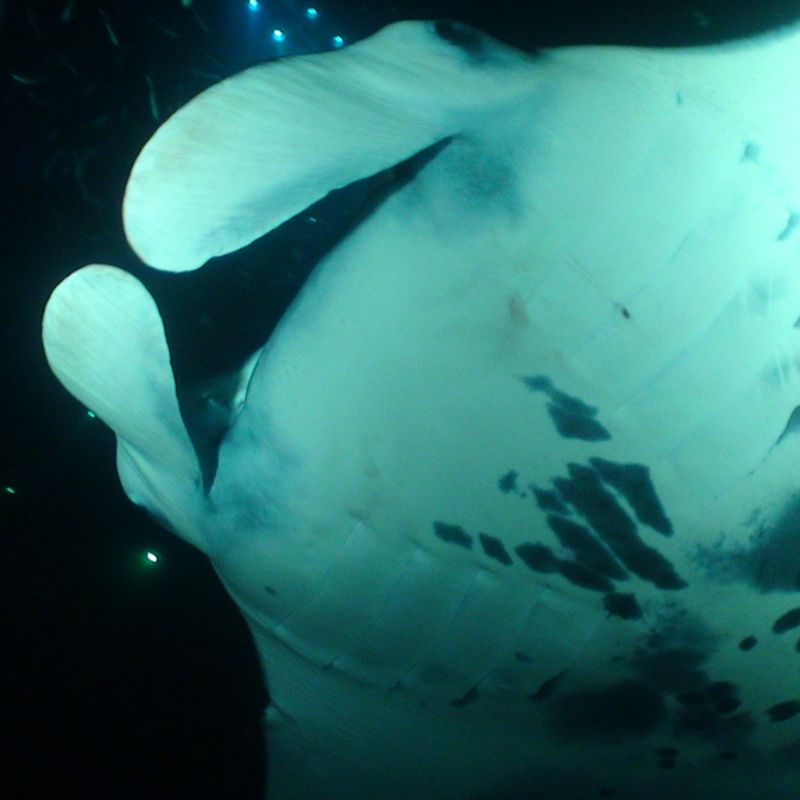
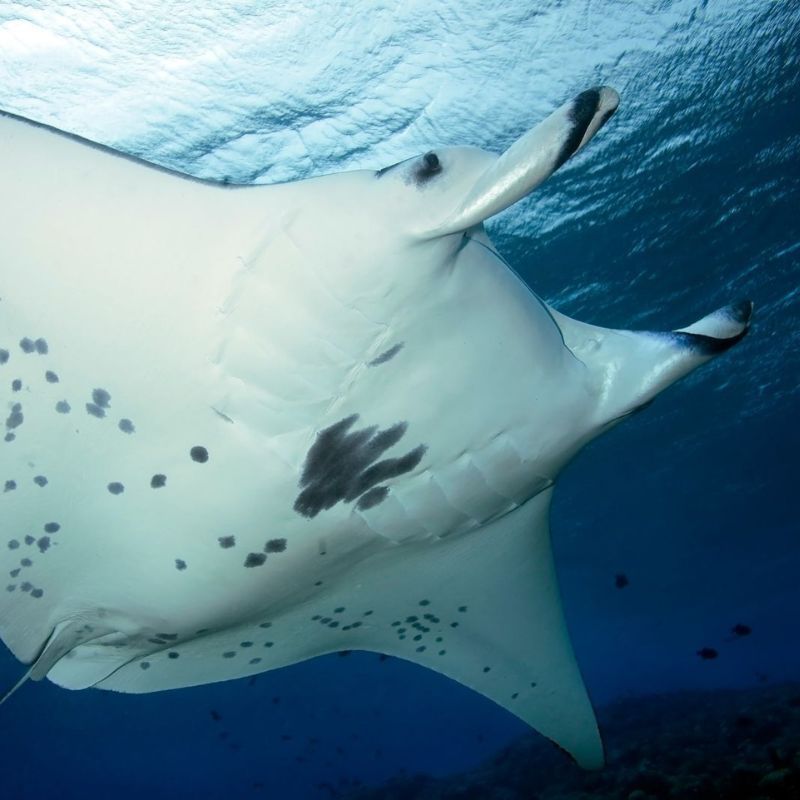
Most pelagic mantas have a black back with light markings on their head that form a clear T-shape with sharp edges. Unlike reef mantas, their faces are much darker, with black coloring around the eyes and inside the cephalic fins. Their underside is also white, but most of the dark spots are concentrated on the lower belly.
Check out this video of a pelagic manta that got called “Black ray,” who is almost entirely black.
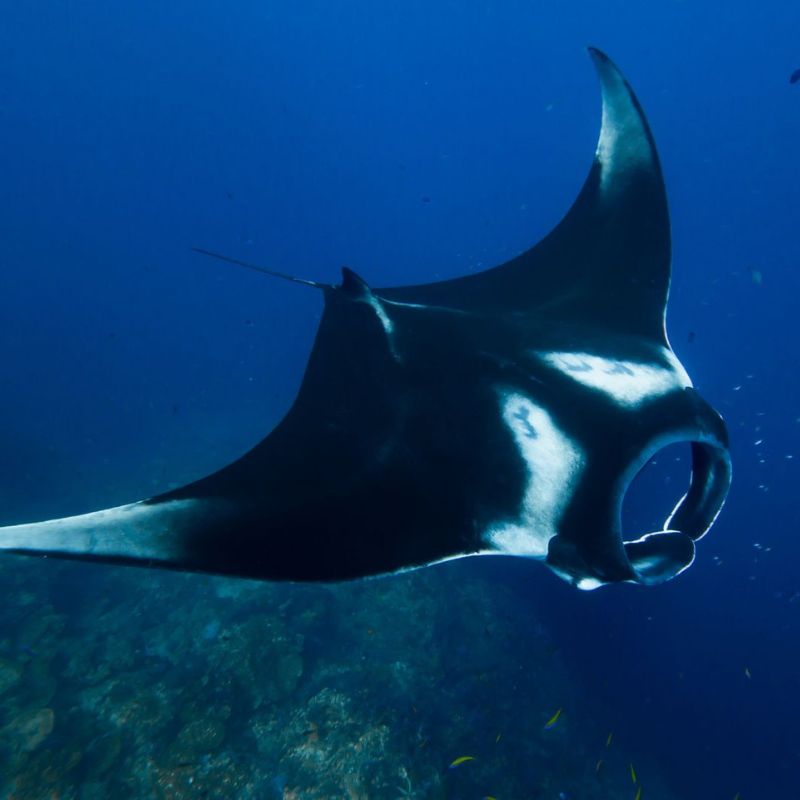
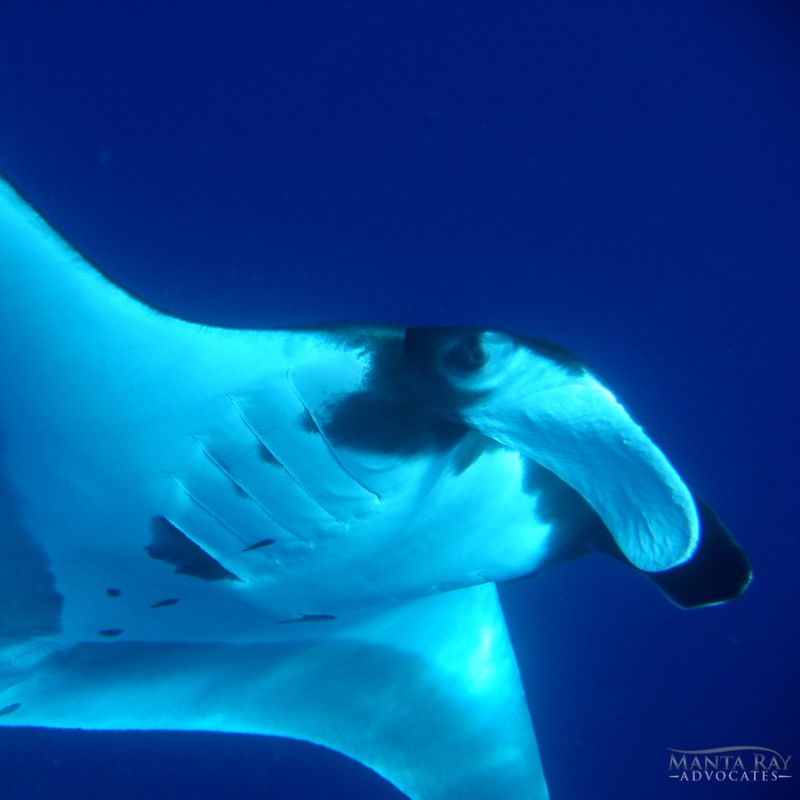
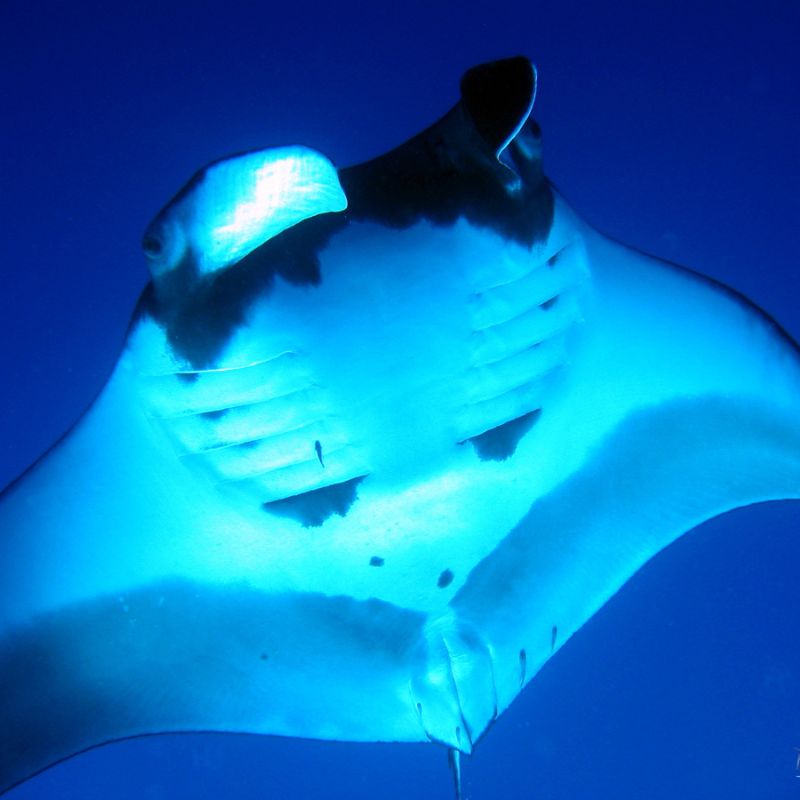
Atlantic mantas show a mix of both. From above, they look similar to giant mantas. From below, they look more like reef mantas.
Their most distinctive feature is a V-shaped white marking on their shoulders. They often have lighter coloring around the mouth and eyes. On the underside, their spots are mostly on the lower belly and don’t extend between the gills like reef mantas.
You’ll find close-up photos of the Atlantic manta ray on the website of the Marine Megafauna Foundation.
The pattern of spots on a manta ray’s belly is unique to each individual, like a fingerprint. This is how researchers and divers identify and track individual animals over time. There are photo ID databases around the world that help monitor manta populations and movements.
At Manta Ray Advocates, we’ve built our own library of (mostly reef) manta rays spotted along the Kona coast – check it out here. And if you’ve been lucky enough to spot one of these gentle giants on a manta dive, you can share your experience on their page!
Difference #4: Behavior and lifestyle
Beyond their appearance, each manta species behaves differently depending on how and where it lives.
Reef manta rays are the most predictable and easiest to observe. They often visit the same “cleaning stations” on coral reefs, where small fish remove parasites from their skin. Many individuals return to these exact spots for years.
Pelagic manta rays live a more nomadic life. They move across large areas of open ocean. They are usually seen alone, but can gather in groups to feed or mate. They can also dive very deep – over 1,000 meters – but are still sometimes seen feeding near the surface.
Atlantic manta rays seem to fall somewhere in between. They are often found in coastal areas, so people encounter them more often than giant mantas. But unlike reef mantas, they don’t stay in one place. Instead, they move along larger stretches of coastline. Scientists are still studying their behavior, but it’s clear they use both shallow and deeper waters.
How to identify a manta ray in the wild: quick guide
If you’re lucky enough to encounter a manta ray, here’s a quick identification guide:
- Look at the back pattern first. Is it a Y (reef), T (giant), or V (Atlantic)? Are the edges blurred or sharp?
- Is the area around the mouth and inside the cephalic fins white (reef/Atlantic) or black (giant)?
- Check the belly spots. Are they spread all over (reef) or clustered in the lower belly area (giant and Atlantic)?
- Are you in coastal Indo-Pacific waters (likely reef), open ocean anywhere (likely giant), or western Atlantic coastal areas (possibly Atlantic)?
- Is it hanging out at a cleaning station or feeding in a group near shore (probably reef)? Solitary in open water (probably giant)?
Each type of manta faces different threats
Reef mantas are listed as Vulnerable on the IUCN Red List. Because they live close to the coast, they are more exposed to human activity. This includes tourism, pollution, coastal development, and fishing. The good side is that they are easy to find, which makes them ideal for responsible ecotourism that can help protect them.
Pelagic mantas are listed as Endangered. They reproduce very slowly, only once every 4 to 5 years. They are often caught accidentally in fisheries, and sometimes targeted for their gill plates, which are sold in some markets even though they have no proven health benefits
Atlantic mantas haven’t yet received their own IUCN assessment. For now, they are grouped with giant mantas. Because they live in busy coastal areas, they face risks like boat strikes, fishing line entanglement, and shrimp trawling, especially in places like Florida and the Gulf of Mexico.

0 Comments